|
|
- Jim Easler, Saudi Trip
-
- In 1965, I was a member of the U. S. Military Training Mission
to Saudi Arabia, stationed at the Saudi Army Air Defense School
in Jidda. Most of us had heard of and seen pictures of Meda'in
Saleh, The Nabataean tombs, and the Hejaz Railroad. We decided
we would like to visit that area.
-
- I prepared a letter to Prince Sultan, The Minister of Defense,
and he granted us permission to make the trip and to use two
Saudi Army Land Rovers. General Mansour Sha'iby, the Area Commander
of Jidda, also detailed Captain Ibrahim Yosuf Omar of the Air
Defense School, to accompany us as guide and interpreter. (Although
two of us had attended the Defense Language Institute before
going to Saudi Arabia. )
| Our trip was made in November of 1965.
We decided to travel and eat austerely so we gathered canned
foods for each meal. We carried a 55 gallon drum of gasoline,
none of us knowing just where gas would be available or how far
apart service srations might be. As it turned out we found gas
stations all along the route and had to resort only once to using
that which we carried. We also carried cans of drinking water. |
 |
- We left Jidda about 8:30 or 9:00 AM in the two Land Rovers
and with Capt Omar driving his personal car. His wife was from
Medina, and accompanied us that far. Members of our party were
Major Everette Perrin of our Riyadh detachment; Air Force Sergeants
Throckmorton and Weesmer both of the Jidda Air Section; Jim Kammert,
a civilian employee of the Jidda office of the First City National
Bank of New York; Capt Omar; and myself, Major Jim Easler of
the Saudi Air Defense School.
-
- We drove northward from Jidda along a first rate asphalt
highway, passing numerous small towns most of which had food
and gas facilities. Larger towns were Rabigh, about half way,
and Badr Hunayn, where there was a fork in the road. The left
fork went to Yenbo and the coast. We took the right fork northeast
toward Medina. By late afternoon we reached the southern outskirts
of Medina and Capt Omar called a relative who came out to meet
us and drive Caot Omar's wife to her family. (In Capt Omar's
car)
-
- Capt Omar also called the office of the Amir of Medina (per
instructions from General Sha'iby) We were given permission to
proceed northwestward around the city along a route being prepared
for paving a new highway that would bypass the city. We would
come back to the main highway at the airport just north of town.
We could then decide if we wished to continue on or remain overnight
at the airport.
-
- By the time we arrived at the airport it was dark and about
8:00 PM or so. Capt Omar called again and informed the Amir that
we decided to stay the night at the airport. The Amir sent us
out two big trays of food -- traditional heaps of rice and meat.
We had had our austere meal south of town but this food was much
better and very welcome. We had come about 400 km from Jidda.
-
- We took our sleeping bags up onto the roof of the airport.
There was no night air traffic and there were only a few workmen
around the whole facility. It was dark on the roof and the stars
shone very bright with the absence of bright lights. We thought
we were in for some uninterrupted rest..
 |
About 11:00 PM we had the first of a number of "experiences"
when two employees came to get our opinions on driving from Saudi
Arabia to Europe. Was it best to drive through Lebanon, Turkey,
and the Balkans or to drive through Egypt, all across North Africa,
and cross over into Spain? We left it to them but suggested that
the drive across North Africa might be worse, especially in summer
We arose early the next morning, getting away before
the crowds came in and air traffic resumed. We headed north toward
Al Khaybar, about 170 km away. South of Al Khaybar we ran into
our second "experience." Sections of the highway had
been washed out by heavy rains and flash-floods.l Since our Land
Rovers were 4 - wheel drive we were able to help several cars
that had tried to drive through the rock and sand, back onto
the roads.
|
|
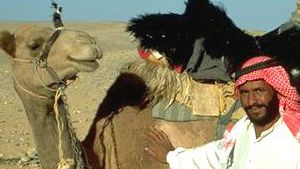
As we left Medina airport, we gave a Bedouin a ride. He was
going as far as Al Khaybar. He had an old bolt-action rifle that
had seen better times. I didn't get to look at it too closely
as he seemed to be the sort of fellow who didn't want anyone
messing with his weapon.
-
- When we got to Al Khabar, we went top the police station
to ask about where we should turn westward off the main highway
to go to Al Ula.
-
- On the wall of the station were several pairs of old handcuffs
and leg irons. The police told us that at a big bend in the road
there was a road sign on the left side that someone had spray-painted
"Al Ula" and drawn an arrow westward. This was a route
that the truckers took out across the desert - only a track where
vehicles had been driven.
|
 |
 |
We drove on northward to that sign, started
out across the desert and in about an hour ran into another"experience."
This came in the form of a heavy downpour that included marble-size
hail. The windshield wiper of the second Land Rover wasn't working
and we lost contact with each other. Fortunately we met up again
after about 45 minutes of separation. |
| We drove on through the afternoon and finally
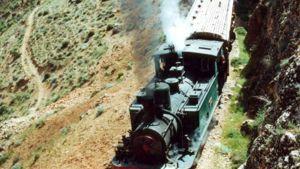
came to the old Hejaz Rail Road roadbed at Qalat Zammurad Station.
We stopped to look over the station - inside and out) It resembled
more a fort than a railroad station. The rail line was being
dismantled and there were stacks of rails and cross ties all
around. The latter were not wooden like the ones we are familiar
with but rather, they were made of iron. Most were in good shape
even after nearly 50 years but suppose the arid desert air did
not cause them to rust.. We also assumed that in days gone by,
there was no chance of Bedouin digging them up to use as fire
wood. We ate our snack supper and headed northward when we discovered
that we had a flat tire. We would later be sorry we did not bring
along extra mounted tires. |
 |
-
- We drove on paralleling the railroad road bed as darkness
fell. Later we saw off in the distance what appeared to be a
string of lights. Eventually we came to Al Ula and found that,
indeed, it was a string of lights -- about a block or two of
Coleman lanterns strung along the street. We drove to the buildings
that had been a Hejaz Rail Road station and found that they had
been converted into the offices of the mayor. There was a bit
of consternation as he had not received a message of our coming.
This was soon straightened out and he took us in and gave us
part of a second floor "majless" (den) covered with
Persian rugs. We brought up our sleeping bags and spent a blissful
night.
 |
 |
- Wed awoke to a beautiful morning and immediately saw
that Al Ula was literally an oasis. There were acres of palm
trees in the valley around the old railroad and stark hills,
mesas and far-off mountains. (Pictures show Al Ula RR Tracks,
windmill anpve, & sunrise below.) Again we were treated to
a meal as the mayor sent us breakfast -- hot tea, pita bread,
jelly, and good, canned Australian cheese. We were also informed
that he would send a policeman along with us to Meda'in Saleh,
as a guide. After breakfast and a short walk around the station
we departed northward. We hadn't driven long when we stopped
at what would be a day-long succession
of "experiences," adventure, and wonder.
- There was a huge, ancient cistern and behind it, stretching
up into some hills, a large pile of rubble of stone and mud brick.
It looked as if it had been a part of a town. These ruins seem
to fit into an old story about a camel that I will relate shortly.
(Pictures Below: Cistern, restoration of well, Me in the rocks.)
We ambled through the ruins and one of our group found a flat
piece of stone with an ancient writing on it. I found a stone
about 1" thick and about 4" in diameter that appeared
to be some sort of hand-held grain grinder. I also found what
looked like half a stone mortar -- about 8" - 10" long,
4" high, and weighing about 8 or 10 pounds. It had a bowl-
shaped middle. (I later gave this to a member of the US Embassy
in Jidda but I still have the grinder.)
 |
 |
- Above: From this location looking to the west, we could see
a great, blue mountain in the distance. We were told it was called
The Mount of The Camel after a fable about the valley people
and a she-camel. Seems the people shared the oasis with the camel
lbut grew jealous of her even though she provided milk in abundance.
They contrived to have her killed by placing spears along a narrow
defile through which she passed. As the story goes, her "na'qa"
baby camel, disappeared into the mountains -- hence the name
for the blue mountain.
 |
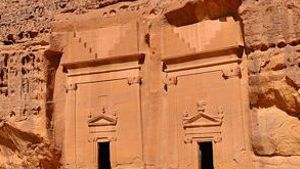
From the cister and ruins we drove on a way and came out into
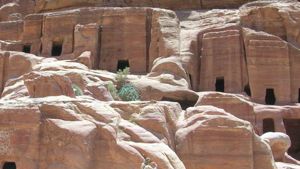
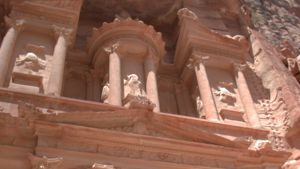
a very wide valley -- Meda'in Saleh. Everywhere you looked you
could see the great facades of the tombs, cut back into the hills
and cliffs. One was even cut into a single, sarge stone, called
Qsar Farid.
|
- We drove up close to several tombs and went inside. There
were low ceilings and not much room inside. Strange' these could
have been the dwellings of cave-like people rather than tombs.
Of course there was little to see inside. Centuries of travelers,
tradesmen, Caravaners, pilgrims, and thieves had long since plundered
the tombs. It was hard to imagine that people could cut and chisel
these enormous caverns over 2000 years ago without modern tools.
-
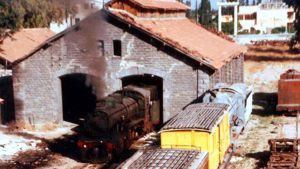
- We spent about two hours looking around at the various tombs
then headed toward the old Hejaz Rail Road repair shops that
were in Meda'in Saleh. We found those in a state of ruin and
abuse. Few tiles remained on the roofs. Doors swung on rusted
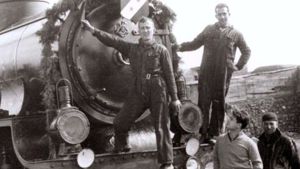
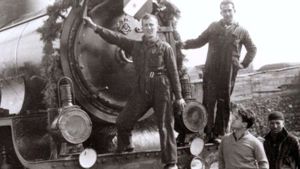
hinges. But there remained in the shops, the skeletons of several
box cars and the remains of an old steam engine. These must have
been there for as many as 45 - 50 years -- since Prince Faisel
and Lawrence of Arabia raided the railroad or at least since
the end of World War I.
- What a day of surprise!!! We were seeing things that
thousands of people had seen -- but very few of them Westerners.On
our way out of Meda'in Saleh we ran into a trucker who's truck
was off the road, in the sand where his young driver had driven
it -- with a broken axle. After talking awhile with him he decided
he would ride back to Medina with us where he could get a new
axle. We dropped off the policeman as we passed through Al Ula
and thanked the Mayor for his hospitality
| We drove southward to one of the stations
between Al Ula and Qalat Zammurad where we decided to have supper.
As we finished our meal, we noticed flat tire number two. Not
knowing what we could run into further on, we decided that Capt
Omar and I would return to Al Ula to get the tire fixed - we
would then have one spare in good shape, We found the Mayor's
driver who agreed to fix our tire. He then found that the tube
was ruin ed so we had to find a shop and buy a new one. With
our fixed spare, Capt Omar and I set out to rejoin our comrades
as it began to get dark. |
 |
- Finally we made out a fire off in the distance. We blinked
our headlights and saw lights blinked back at us --- TWO SETS
OF HEADLIGHTS!!!. As we pulled up to the old statikon, we saw
another vehicle beside our Land Rover. Our friends had been joined,
after our departure, by a group from the Saudi Ministry of Agriculture.
They had brought out their tea kettles and coffee pots and settled
down to keep our friends company until our return. Major Perrin
had been able to talk some with them as he had attended the Def
Lang Inst in California. It was also found that the elder of
their group had been a telegrapher with the Hejaz RR and knew
Morse Code. Sgt Throckmorton had aircraft radio experience and
the two of them had exchanged a few phrases and entertained each
other by tapping on the fender of the truck.
 |
They offered to accompany us back to Al Ula or to let
us have one of their spare tires. We turned both offers down
and after they departed, we drove on to Qalat Zammurad Station.
We brought out our sleeping bags and folding cots and spent the
night by the old railway bed. The n ext morning we had breakfast
and started for Al Khaybar. We had considered going by way of
the rail line but decided that we knew nothing of the type road
we may find. We came across two men and a camel They offered
us rides on the camel. Capt Omar tried - they had no saddle -
by holding on from the rear of the hump. The camel was a rather
disagreeable sort so the rest of us passed on camel riding.
The rest of the trip was uneventful. We dropped the truck
driver and Capt Omar at Medina. It was about 10:00 PM when we
made it back to Jidda.
|
- It was a fast, hectic, trip but we enjoyed the various experiences
we had, the people we met, and especially getting to see the
remains of the Hejaz Rail Road and the Nabataean tombs. My Army
travels, schooling, and adventures were of great help after I
retired and became a high school history teacher in Greenville,
S. C. JIM EASLER; Lt Col; US ARMY RET
-
-
-
- If you have a story or account of the railway and
would like to have it posted, please contact
us.
-
-
- Other Rail Lines and Miscellaneous
Pages
|