|
|
|
|
Further Considerations Having now surveyed an array of evidences for the identification of the Hyksos Kings with the Biblical Edomites, it is hoped we may confidently speak of them as one people, the Hyksos/Edomites. At every point the references to each so coincide and tally that we feel justified in so doing. "But, someone may object, "Not one of the points
cited in the foregoing chapters in itself constitutes absolute
proof." Still, without giving absolute proof, some may yet insist; so that the argument for the theory in unconvincing. We believe that this may be very difficult. Nomadic people leave little behind them in the way of buildings, monuments, and written records. If the entire Edomite Kingdom was based on nomadic tribes raiding the Arabian Peninsula, then there may be little physical evidence of their existence. However there are some interesting comments made by the Israelites of the time. Consider the words of Moses' triumphant song when Israel came through the Red Sea, and the Egyptians were drowned.
If one remembers that not too long before the Exodus of Israel from Egypt, the sheiks of Edom were chased out of Egypt by Ahmose I, one can see why they would be simply amazed beyond measure to learn that the slave nation Israel had actually been able to march out of Egypt as victors. The sheiks, comparing the report with their own humbling expulsion from Egypt, would be filled with wonder and astonishment. They, rulers of Countries, dominating Egypt and reigning as
Pharaohs in it, were expelled: Israel, crushed into helpless
slavery makes a triumphant Exodus. What a contrast! The sheiks
of Edom were amazed. Now we can see the true, deeper meaning in the words of Moses'
song. The words take on real life. How exactly appropriate they
were. Thus the identification of Hyksos/Edom assists the student
of Scripture to better understand what he reads, and gives reality
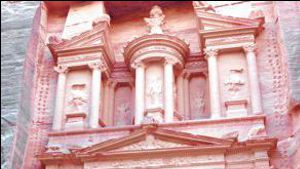
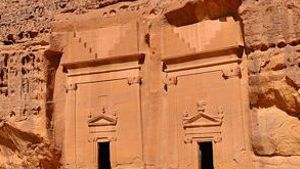
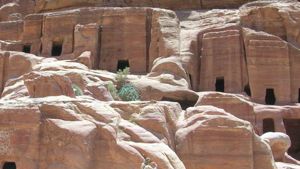
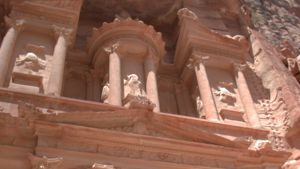
to the passage. If our theory is right, one needs but to compare Edom and Egypt to see one very good reason. (35) Egypt was so much more attractive to live in than the deserts of Edom, that such a move is seen to be the obvious, most natural and logical thing to do (Gen.l3:l0). We have already noted from the Biblical record that King Saul of Edom did not hesitate to set up his first capital at Rehoboth by the Euphrates, a long, long way off from Edom itself. This trait gives away the similarity if not the identity of Edomite and Hyksos. The only reason we can suggest for making this move, is having a place where he could graze the thousands of horses and camels that he must have had at his disposal. If the horse had given the Edomites the edge in battle, then the various sub-tribes and surround tribes of Edom must have joined in on the raids. Thus it became physically impossible for these raiders to camp in any large numbers except in well watered plains where there was plenty of forage for their horses. This argument would also apply equally as well to the Hyksos/Edomites setting up their capital at Tell el-Dab'a in the heart of the Nile delta. What the Hyksos Kings Took with Them As we said before, the Edomites in their retreat seem to have fallen back right to the east side of the Arabah Valley. All the extensions of the empire fell away, only the Edomite core was left. This would bring the Hyksos/Edomite leaders remaining, right to Bozrah which had been the capital under King Jobab. Yet it is unlikely that Bozrah was fortified at this time. The Edomites had originally occupied thee country as nomads, and, as M. E. Kirk puts it, the majority seem simply to have pitched their amid the ruins of the conquered cities. ("Outline of Ancient Cultural History of Trnsjordan" Palestine Exploration Quarterly, July-October 1944, p 180) The Israelites later did the same when they overran Canaan. It was not until well over three hundred years had passed that the Israelites began to really build cities. (Those who argue for a late invasion of Canaan by Israel, around 1200 B.C., have perhaps overlooked the fact that too little time is left for nomadic Israel, fresh out of the wilderness wanderings to switch over to a city-dwelling state.) City dwelling seems to have begun even before the time of Samuel. The Hyksos/Edomites had occupied cities outside of their home-land, but appear to have utterly neglected the building cities in Edom. At least, archeologists have not yet found trace of any in Edom at this period. Thus, thrown back to the region of Bozrah, the Hyksos/Edomites would have little or no defense against Egyptian pursuit. The City Petra and Beidha Tossed back out of Egypt into nomadism, perhaps the Hyksos line of kings collapsed altogether and a new line took over. Perhaps the line continued in a weakened state. We do not know. However some of the people had tasted life in Egypt. It would take a while to become adjusted. Not so very long after the Hyksos Expulsion which was about 1580 B.C., a great change began to come over the Land of Edom. The people commenced agricultural activities. They started to settle down. City life appeared. By about 1300 B.C. a line of fortified sites marked much of the boundary or Edom. Was it not the return of the Hyksos peoples from Egypt which gave the impetus to accomplish this in less than 300 years? Somewhere about this time Petra, the famous and beautiful rose-red Rock City, was most likely settled. Most scholars speak of the monuments in Petra as being of Nabataean skill (around 300 to 200 B.C.), which is no doubt true for the most part. But excavations are starting to demonstrate that the valley was occupied at earlier times as well. The Hyksos/Edomite peoples having brought back with them some of the marvelous stone-art techniques learned in Egypt, in process of time, began to carve out rock dwellings and temples in the living rock or the faces of the mountains enclosing the site of Petra. Although the city has passed through a brilliant Nabataean stage since, let us, when looking upon these huge, rock temples, think back upon the Hyksos kings. Expelled out of Egypt, yet handing down stories or the greatness which had once been theirs and longing for greatness still; then setting about in that dry land to carve out great and beautiful temples of their own and they evidently achieved success. Oddly, one of these immense rock temples, facing the narrow entrance passage, today bears the Arabic name "Khaznet Fir'aun" or "Treasury of Pharaoh." Another is called "Kasr Fir'aun" or "Pharaoh's Palace." It is a puzzle as to why the title "Pharaoh" so emphatically Egyptian, should crop up, seemingly without reason, at Petra. It is as if the names are trying to whisper something to us of a connection with the land of the Nile; as if saying softly, "Our ancestry harks back into a dim past when the early kings of our line were once real Pharaohs." Edom, "A Famous Nation" They give it a prominence of position that heretofore has seemed all out of proportion. To those writers the Edomites bore with them the memory of a once great, dominating empire. One example of the enlightenment and help our theory provides is found in connection with the passage in Ezekiel 32:17-32. Here the Prophet Ezekiel sings a sorrowful, picturesque dirge over the fall of great and powerful Egypt before the arms of Nebuchadnezzar king of Babylon. He cries that the multitude of Egypt will go down in death into the abyss; she (that is, Egypt) with the daughters of "the famous nations, unto the nether parts of the earth" (vs. 18). There, the strong among the mighty shall speak to fallen Pharaoh out of the midst of hell (vs 21) Now, let us ask, who are these "famous nations" and the "strong among the mighty?" The Prophet Ezekiel proceeds to list the famous nations as known in his day. Most naturally the first is "Asshur" or Assyria, in verse 22, "which caused terror in the land of the living." Next is "Elam" in verse 24, which also caused its terror in the land of the living. Then "Meshech" (and) "Tubal", which are the Mashki and Tabal known to us from Assyrian inscriptions, and likewise "caused their terror in the land of the living." Then follows, to the surprise of thoughtful students, in verse 29, "Edom, her kings, and all her princes." The parade ends with "the princes of the north" (the Scythians were pushing in from the north at that time), and the "Zidonians" in verse 30. But we ask, how marches little Edom in this parade of what are described as the famous nations? Why did Ezekiel include Edom in this array of "the strong among the mighty"? Regardless of how much of this chapter is figurative, and how much literal, we are forced to admit that even down to the prophet's day Edom was viewed as a "famous nation" with something in its past to elevate it to the position of one of "the strong among the mighty." Little toddlers do not march in a parade restricted, let us
say, to accomplished scientists such as Isaac Newton, Michael
Farady, Lord Kelvin, Jeans and Einstein! If Edom was the little
kinglet we have heretofore thought it, it would have been barred
out from being mentioned with Assyria, Elam, Mashki, and Tabal
in such a listing? But the inclusion of Edom is positive proof
it was considered an unusually powerful country. End of Chapter Nine |
| Foreword | |
| Chapter One | The Enormous Hyksos Empire |
| Chapter Two | The Mixed Origin of the Edomites |
| Chapter Three | The Birth of the Kingdom of Edom |
| Chapter Four | The Book of Job |
| Chapter Five | The Hyksos-Edomite Empire |
| Chapter Six | The Hyksos Used Horses |
| Chapter Seven | Religion and Date of Edomite Empire |
| Chapter Eight | Where Did They Go? |
| Chapter Nine | Further Considerations |
| Appendix 1 | End Notes |
| Appendix 2 | Earliest Horses in Egypt |
| Appendix 3 | Hyksos Influence in Canaanite Cities |
| Appendix 4 | Comparison Table |
| Appendix 5 | Chronological Table |
| Appendix 6 | Maps |
| Appendix 7 | Bibliography |
|
|
|
|