Land of Edom Header
The Hyksos, Kings of Egypt and the land of Edom

This document sets forth the theory that the Edomites were the ancient Hyksos who invaded Egypt. If you are interested in investigating such a theory, we ask that you extend us the courtesy of starting at the beginning of the document, in order to follow our line of reasoning. Please note that this document has been split into fifteen web pages and comprises over 30,000 words. It was first published in 1962 under the title “Whence Came the Hyksos, Kings of Egypt” and has been revised and updated for publication on this website.


 CHAPTER III
The Birth of the Kingdom of Edom

"I shall speak concerning a nation and concerning a kingdom, to build and to plant it" Jer. 18: 9.


After Jacob returned from Reran in Padan-aram, at which time he and Esau were reconciled, events began to move rapidly (Gen.32-33). Jacob sojourned for a short while near the city of Shechem (Gen.33 18-20). Esau had part of his extensive herds and flocks in "Seir" that is, in the country on the south and south-east of Canaan including the wilderness comprising the north-east portion of the Sinai Peninsula (Gen.32:3, 33:14, 16), while the rest of his herds and flocks were with his father Isaac at Beersheba in southern Canaan.

A quarrel soon arose between Jacob's family and the Hivites in the city of Shechem, which ended with Simeon and Levi, two of Jacob's sons leading a furious, surprise attack on the city and slaying all the adult men. The wealth of the city was seized, and the women and children carried captive (Gen .34: 25-29). Jacob was much disturbed over this, fearing all the surrounding Canaanites tribes or nations would unite to attack him with overwhelming odds (Gen. 34:30).

This particular incident gives us an insight into the large number of "servants" held by Jacob and the military strength of his followers and of the Patriarchs generally. Jacob had enough men at his bidding to have no particular fear of any single Canaanite tribe, but this military act of his angry sons might be expected to incite such a united attack as he could not withstand.

God restrained such an attack from coming. One element that might have had a bearing would be the fear the Canaanites felt of reprisals from Jacob's powerful relatives his father Isaac, his brother Esau, and even the more distant relatives in Haran. In any event, "the terror of God" fell upon the Canaanite cities and they left Jacob and his followers alone (Gen. 35:5).

Jacob hurriedly began moving his whole retinue and his flocks and herds southward to be nearer Isaac and Esau. He paused at Beth-el and then moved on southwards. Finding he was not perused, he established his headquarters for a while near Edar. Then he continued on southward and came finally to Beersheba where Isaac lived, physically feeble, advanced in age and blind, yet evidently mentally alert, controlling, and directing the business affairs of his own great cattle herds.

A new problem now arose. Jacob and Esau each had great herds. The combined consumption of pasture was more than the area could provide. There was not enough grass. However, no strife or quarrel took place between the reconciled brothers. A satisfactory solution was arrived at.

Esau Does Right
Mellowed, Jacob seems to now take over the leadership of the family. Isaac, greatly handicapped by loss of sight and evidently weak and frail in body, hands over to Jacob the family authority and the priesthood, and his own possessions and wealth. Jacob thus is acknowledged to hold that religious title to the promised, ultimate possession of the Land of Canaan, handed down from its first recipient Abraham. Esau took his servants and his herds away, out of the Land of Canaan altogether, from the territory he now rightly recognized as assigned to his twin brother, and moved everything southward into "Seir" (Gen. 36:6-7). In this Esau did right, and the prosperity that thereafter came upon the Edomites, as we shall see, may have been partly God's reward for Esau's right act in this case, though nothing could undo his former act or restore what he had forever lost.

The Horites
In this country of Seir there lived a people called "Horites" or "Horims." Esau's family, the Edomites, began to intermarry with them, of which we will tell more presently. First let us consider these Horites. Who were they?

Now, the Horites for many centuries have been entirely unknown to scholars outside of the few references to them in the Bible. The Horites were thought to be just a little desert tribe, insignificant and rather unimportant, or, after the rise of the higher critical views, could even be considered to be nothing more than fable, a product of the imagination of the Biblical writer's mind. This was so until in recent years the archaeologist's spade began to unearth simply astounding information about them. We are at last finding out the truth. Today we are now beginning to view them in an utterly different light. We realize the Horites were a most important and far reaching factor in early times, but were later completely forgotten except for what the Bible preserved to us. This point alone demonstrates for us both the great the importance and real value of the Biblical records, and that the Biblical record does indeed reach back an exceedingly long way into forgotten history. What the Bible has done in preserving a memory of the Horites, it may (we say, it has) done in still earlier records which the present modern and liberal schools of thought think are only myths and vague uncertain traditions.

Thanks to the diligent activities of archaeologists and scholars, the Horites have been brought to light. We find frequent mention of them on ancient monuments and in clay tablets. The Egyptians called one district southerly of Canaan by the name, "Khar." This is evidently "Hor" It reminds us of Mount Hor in the region of Seir where the Horites lived. The references to these people in the clay tablets was formerly translated "Harri," but is now more correctly given as "Hurri," a phonetically close equivalent of "Hori" (Gen.36:22).

The Horites living south of Canaan, as we learn from the Bible account, were under the leadership of a family, the descendants of a man named "Seir the Horite" (Gen.36:20). The district was presumable known as "Seir" after his name. They were the inhabitants of the country in Abraham's time, and were looked upon as such important allies of the king of Sodom that Chedorlaomer the king of Elam felt the need of defeating them first before he could safely attack Sodom itself (Gen. 14:1-7). The region called "Mount Seir" at that time apparently extended westward as far as El-paran (possibly "Nakl" near the centre of the Sinai Peninsula), beyond which lay the Wilderness of Shur, stretching to the borders of Egypt (Gen.14:6).

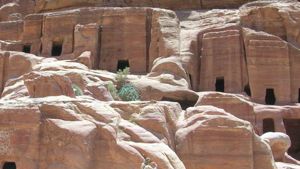
"Paran" means "Place of Caverns," and "Horites" means "Cave Dwellers" according to older Bible Dictionaries, which produce a happy harmony of meanings, at least. But there is now a great doubt on this point. Dr. Merrilll F. Unger, in his book, "The Dead Sea Scrolls and Other Archaeological Discoveries," (Zondervan Publishing House, l957 states on page 74: "This unknown people used to be thought of as a very local and restricted group of cave-dwellers, the name Horite being derived from Hebrew hor, ('hole' or 'cave')... As a result of the discovery of the Hurrians, the popular etymology which connects them with troglodytes, or cave dwellers, has generally been abandoned." However, we here need to step cautiously, as we do not yet know what the state of their cu1ture was or the type of dwelling used by those Horites living in Seir south of Canaan. It is important, however to notice that the whole region of Nabataea and much of the Negev is filled with thousands of shallow caved, and that many of these caves were used as dwellings throughout the centuries, up until only a few years ago.

One important point we should notice is that in the earliest times "Mount Seir" seems to be in the mountainous region west of the Arabah Valley.

Later the term is used of both sides of the Arabah Valley, and more recently many have confined it to the east side only. This helps explain how it is that the names "Paran" "Seir" and "Sinai" are synonymous with "Horeb," the Mount of the Law (Deut. 33: 2; Hab. 3: 3). The statement that there are eleven days journey from Horeb to Kadesh-barnea "by way of Mount Seir" (Deut.l:2) is seen to be quite natural, if "Mount Seir" included the ring of mountains about the southern edge of the desert plateau of Sinai, known to the Arabs as Jebel el Tih. These mountains have to be passed when going from Sinai to southern Canaan where Kadesh-barnea was located.

A Horite Kingdom
Archaeology has revealed that there was a Hurrian (Horite) Kingdom in Mesopotamia. It was east of the Kingdom of Mitanni. Mitanni occupied land on both sides of the Euphrates River north of Carchemish (12) The Hurri and the Mitanni, we learn, were closely related peoples, and these in turn were related to the Hittites of Asia Minor. (See "Archeology and the Bible" by George A. Barton, Ph.D.) The language of the Hurri is said to be not Indo-European. As Bible students would say, it is not "Japhetic," not of the nations descending from Japheth, the elder son of Noah.

Neither, it seems, is the Hurri language to be classed as Semitic. Hence, it appears it would be Hamitic, using the word "Hamitic" in its broadest sense as including all languages which are neither Indo-European nor Semitic. The Bible does not state where the Horites came from, but the inference from the language of the Hurri is that they came from Ham, Noah's younger son.

That the Horites were not confined to the above mentioned kingdom, the archaeologists have found to their surprise. The Bible itself tells of the one group of these people south of Canaan. But mention of the Hurri or Horites is cropping up in unexpected places in Assyria and Babylonia. In the city Nuzu, near modern Kirkuk in Iraq, the Hurrians became a very strong element soon after 1800 B.C. In fact, they seem to dominate much of the Near East at that time. Again about 131 Hurrian clay tablets were found under the ruins of a temple at Shimshara in the Dokan Plain. (See "The Christian" London England, Aug. 30, 1957, page 2.)

In 1958 a Danish expedition examined a Hurrian settlement in Northern Iraq, near Sulaimaniya. This settlement appears to date from about 2000 B.C. down to about 1500 B.C. This is the very period of history with which our study deals. It ties in nicely with our theory.

These two peoples, Esau's family the Edomites and the leading Horite family of Seir, began to intermarry. Eliphaz, Esau's eldest son, married Timna the sister of Lotan and the daughter of Seir (Gen.36: 12,20, 22). From this marriage to a Horitess was born Amalek. He grew up to become a sheik of Edom and is considered to be the progenitor of the Amalekites. According to this view, the Amalekites would have originally been a tribe of Edom. (Some people have suggested that the Amalekites might have been the Hyksos, but, as we shall show later, the Amalekites were simply a sub-tribe of the larger Edomites during the time that is in question.) (For more information see the website: Chronologically Helpful Parallels between the Hyksos and the Amalekites http://www.specialtyinterests.net/hyksos.html#amada)

The Amalekites inhabited some parts of the desert plateau of Sinai, previously occupied by the Horites as we have seen. Now in Genesis 14:7 we read that Chedorlaomer smote the country of the Amalekites when it appears that the Amalekites had not come into existence at the time. The simple explanation is that the account refers to the country occupied by the Amalekites at the time Genesis was written. In just the same way we might say the American Indians were roaming over Canada before Columbus set sail, when there was no such country as Canada then. We mean, of course, what is Canada now. Just so, the author of Genesis meant that Chedorlaomer smote the county to which the Amalekites later gave their name: he did not state that the Amalekites were smitten, which would have been an error. Horites most likely occupied it then.

The Egyptians had no "L"
The Egyptians had no initial "L" in their language. (13) In this they were in a difficulty similar to the Chinese, who, contrariwise, dislike beginning a word with "R." Most Chinese people feels they must substitute another sound, so uses "L" instead of "R," until they master the unfamiliar sound. Thus they tend to call a red rock a "led lock." In exactly the reverse manner the Egyptians substituted "R" for "L" in foreign names.

The Horite name Lotan came difficult to the Egyptian scribe. Dr. Barton tells us they substituted "R" for "L" and called it "Rutenu." This name is found in records of the time of the Twelfth Dynasty of Egypt (2000 B.C. to 1788 B.C.), proving that the name "Lotan" was then in use. Indeed, the name "Upper Rutenu" seems to indicate highlands in Syria, while "Lower Rutenu" appears to apply to some district in the general region which is assigned in the Bible to the Horites, where Lotan was a leader. Thus there can be little doubt that "Lower Rutenu" in the Egyptian records refers to the district of the "Lotan" of Genesis 36: 12, 20, 22).

It is to be noted that this name Rutenu or Lotan is used in the Tale of Sinuhe, during the reign of Sesostris I of the XIIth Dynasty, about 1950 B.C. This demonstrates that the name was in use at that time.

During the XVIIIth Dynasty we meet with a new name for the Bedouin from Asia, the "Shasu." The Department of Egyptian Art at the Metropolitan Museum of Art in New York City informed the Americana Institute of Canada, in response to my enquiry, that it did not know of earlier references to "Shasu" than those of the first half of the XVIIIth Dynasty. Several authorities in their works on Egypt had used the term "Shasu" in reference to earlier periods.

However this appears to be the mistake of reading back into an earlier period a name belonging strictly to a later one. The fact is the Shasu appear first in Egyptian history about 1500 BC. They are not known earlier, and it may be presumed were not there in the deserts east of Lower Egypt very much earlier than that date. Evidently the Shasu were newcomers.

If one will take the time to examine maps covering the region of Edom, as put out by various Egyptologists, it will be found that the names for Edom ("Seir," "Aduma" etc.) are very curiously pushed hither and yon about the country to make room for the name "Shasu," which is frequently splashed generously around the whole region from the Isthmus of Suez to the Arabian Desert east of Moab, including all the northerly part of the Sinai Peninsula to the southern parts of Palestine. Yet with all this crowding of the one name upon the other, it does not appear to have occurred to any that the two might refer to the same peoples! While we do not claim positive identification, yet it appears feasible that the Sashu are either the Edomites or a name inclusive of Edomites, Amalekites, Ishmaelites, and possibly Midianites. The word "Shasu" means "plunderers" and "robbers," an epithet befitting their characteristic of extracting heavy tolls of all passengers through those regions. But in any case, it is striking to note that "Rutanu" (Lotan) has been replaced by "Shasu" somewhere between XIIth Dynasty times and the XVIIIth Dynasty, just as the Bible states the Horites were replaced by the Edomite shepherds about that time.

Having now joined affinity with the Hurri or Horites of Seir, the Edomites began to become a quite powerful force. Rapidly they budded into a new, small kingdom. We must next look into their king-list, as it contains astonishing hints and implications of growth.

The Early Date of the King List
That the Kingdom of Edom was formed soon after Esau moved all his possessions into Seir, is evidenced by the genealogy of Jobab the second king in the king-list. Of this king we shall have much to say later. We trace his genealogy thus.

One of Esau's later sons was Ruel, born before Esau finally left Canaan (Gen.36:4). Ruel's mother, as we mentioned before, was Mahalath or Bathshemath, a daughter of Ishmael. Ishmael was the progenitor of a number of tribes inhabiting Northern Arabia (Gen.25:13-16). Thus Ruel was part Arabian, that is, part Ishmaelite.

Ruel had four sons. All became sheiks of Edom: the name of the second being Zerah (Gen.36:13, 17). A little further on Zerah is named as the father of Jobab, the second king of Edom (Gen.36:33). Linking these together we find that the second king was great-grandson to Esau.

On this basis, the Edomite king-list given in Genesis belongs to a very early period of Edomite history. The first king, Bela, would be a contemporary, we may well assume, of Zerah the grand- son of Esau. In other words, if Esau enjoyed a life about as long as his twin brother Jacob, he may possibly have seen the first king reigning, or it might be the first king was chosen when Esau, the leader died.

"Before Any King over Israel"
The Edomite king-list opens with the words:
"And these are the kings that reigned in the land of Edom, before there reigned any king over the children of Israel." (Gen.36:31.)

This statement is not necessarily a reference to the setting up of the Israelite monarchy under King Saul, many centuries later. Many Bible scholars feel the two events are altogether too far separated in history to have any bearing upon one another. The events are recorded in different books and by different writers. No, such an understanding and application of the words we have quoted misses entirely the whole significance that was in the writer's mind when he wrote them, overlooking the very point which made Israel, even before the Conquest of Canaan, such a "peculiar people," in the eyes of all other nations. Everyone can see that the writer of the stories of Jacob and Joseph in the book of Genesis was passionately monotheistic, one who believed with all his heart and soul in One Lord God and in the worship of that one God alone. His words absolutely must not be viewed apart from that primary and deep-seated conviction.

Now early Israel, after the Exodus, considered itself to be a kingdom, yet without an earthly or human king. In many countries and nations (14) even down to Japan in recent times, the people viewed their king as their god. It was not so in ancient Israel: their God was their King (Deut.33:5; Judges 8:22-2:3; I. Sam.8:7). The God of Israel had not merely created the heaven and the earth, a far-off, dim event of the past, (and an act more or less claimed for a multiplicity of heathen deities,) but this God had delivered them from Egypt and had defeated and brought low all the power and pride of a Pharaoh of the XVIIIth Dynasty of Egypt. They Pharaoh's of that Dynasty as its zenith were recognized everywhere as the greatest and most powerful monarchs on earth in their day, and claimed to be gods. No wonder this deliverance from Egypt was Israel's glory, the event more often spoken of than any other in all their history. This God of gods, this Supreme 'Being' dwelling in their midst in a cloudy pillar and was Israel's unique King from the day they marched victoriously out of Egypt. For centuries thereafter, Israel could not tolerate the idea of a human king.

Realizing this truth, one can see that the statement the Edomite kings reigned before any king reigned over Israel, simply means that they reigned before the Exodus, that is before Israel came under her glorious King, the God of their fathers and before Israel entered into a blood-covenant with God so that he became the actual, recognized ruler of the nation.

"The Last shall be First"
How different the case was with Edom which had lost the Abrahanic Covenant, and slowly drifted away from the Abrahamic traditions and worship. Edom got her kingdom first, long before the Israelites. The Israelites got a promised blessing, the Abrahamic Covenants, consisting largely of promises, not present possessions. The Israelites had lingered 400 weary years in Egypt without a king. This pattern is often seen down through history. God's people, holding to God's promises, see other prosper and rise to enviable position, while they themselves need to patiently wait and abide God's time. Consider:

(l) Esau made advantageous marriages with the Canaanites; Jacob was restrained from this

(2) Esau mingled with the Horites and gained a country (Seir) for himself: Jacob had to remain a stranger and a pilgrim, a sojourner to the day of his death

(3) Edom soon developed into a little kingdom: Israel moved into Egypt by the sufferance of the reigning Pharaoh

(4) Edom progressed into an empire (as we shall see): Israel was reduced to slavery.

All the advantages seemed to be on the side of those who had lost the Covenant. Those who missed the blessing were blessed: those who gained the blessing were miserable slaves! Yet the day finally came when Moses and the Children of Israel sang victoriously:

The people shall hear, and be afraid:
Sorrow shall take hold on the inhabitants of Palestina,
Then the sheiks of Edom shall be amazed."
(Exodus 14:14-15)

The final victor is the real victor: final blessing is the only blessing.

Even so today. The true church of Christ must be patient. The ones who seek immediate, temporal power, rulership, and a kingdom, lose the blessing even while they think they are blessed with the prospering of their schemes and plans. Those who, contrariwise, embrace the promises and wait patiently for Christ, may be persecuted and despised, and may continue sometimes under sufferance of the world's kings and rulers, or be crushed in prison or concentration camp; yet the day will come when Christ will deliver his own, and the true church will reign with Christ for ever. This is the teachings of the scriptures.

The First King, Bela

"And Bela the son of Beor reigned in Edom: and the name of his city was Dinhabah." Gen 36:32

We have seen that Edom was formed into a kingdom at a very early date, possibly even within Esau's life time. Bela could easily be a contemporary of Ephraim and Manasseh, Joseph's sons in Egypt. By the time Joseph's sons were grown to manhood, Bela may well have already begun his reign as King of Edom, with a number of sheiks under him.

This king Bola, we are told, was the son of Beor. Beor is a name we do not find among Esau's descendents, nor yet in the family of Seir the Horite who occupied the country prior to the coming of Esau's family and followers. It is therefore quite possible that Bela was not an Edomite, nor a local Horite by descent, but someone raised to the position of kingship by the united consent of the sheiks of the Edomites and the Horites.

Balaam the soothsayer, about five hundred years later, is also called "the son of Beor" (Num 22.5). Of course, if that Beor was the immediate father of Balaam, then we have no indication of any connection with the father of King Bela. However, if Beor was an ancestral father of Balaam, (just as the Lord Jesus is called "son of David" though 1,000 years intervened,) then it is possible that both references are to the same person. In that case, this Beor would be a person of great and unusual importance, whom Balaam would especially claim as an illustrations ancestor, thereby to add to his own reputation and influence. He seems to strive to do that very thing in his last two prophetic utterances to Balak, King of Moab, opening his parabolic speeches with emphasis on this ancestral connection, using the words, "Balaam the son of Beor hath said..." (Num.24.3, 15).

Thus it is just possible that Beor, the father of Edom's first king, was some great and widely honored figure of those far off days. If that should be so the location of Dinhabah, the city of King Bela, could be either in Edom or near the River Euphrates like the home of Balaam. Then it likely would be also the home of Balaam's ancestral father Beor (Num. 22: 5; 23:7). However, this is speculation, and may not be so.

The Destruction of the Horites
A very difficult problem is the question as to just where in the history of Edom are we to place the destruction of the Horites or Hurrians. The event is recorded in Deuteronomy 2:12 where the Horites are called Horims.

"The Horims also dwelt in Seir before time; but the children of Esau succeeded them, when they had destroyed them from before them, and dwelt in their stead; as Israel did unto the land of his possession, which the Lord gave unto them."

The conquest by Israel referred to here, was, of course, the Israelite conquest described in the context; the conquest of the lands east of the Jordan River where Sihon King of Heshbon and Og King of Bashan ruled. These Amorite kings were slain by Moses and the children of Israel who possessed and divided the land between the tribe of Reuben, the tribe of Gad and half the tribe of Manasseh. This conquest is spoken of shortly before and is fully described immediately after the verse we have quoted (Deut1:4; 2:24 to 3:2) notice especially the following words; "begin to possess it" Sihon;s land 2:24; "Behold, I have begun to give Sihon and his land before thee, begin to possess that thou may inherit his land" (2:31) "This land which we possessed at that time" 3:13; "The Lord your God hath given you this land to possess it" (3:18) it therefore follows that the land of Israel's possession referred to in 2:12 is not the Land of Canaan taken by Joshua, but the lands east of Jordan taken by Moses.

In a somewhat similar way, the Edomites had previously destroyed the Hurri or Horites. But just when did they do so? Did the Edomites destroy them before the first king, Bela the son of Beor, was crowned? Would they crown a king before possessing a country for his kingdom?

Or did the Horites and Edomites unite to crown the first king and the destruction of the Horites follow at a later time? We simply do not know, because the record does not say. Striking, confirmatory and helpful as the archaeological evidence is, neither does it settle the matter. Nevertheless, let us consider what the archaeologists have to tell us.

Somewhere about the twenty-third century B.C. large, bronze-age cities were established along the great north-south highway which ran through the Transjordan plateau on the east side of the Jordan Valley and of the Dead Sea. This flourishing Bronze Age civilization very suddenly ended. Various authorities appear to differ as to the date. M. E. Kirk ("Outline of Ancient Cultural History of Transjordan," in the Palestine Exploration Quarterly, July-Oct. 1944, p.18l) gives it as "about the end of the twentieth century BC," others have suggested later dates, down to about 1700 BC.

Then follows a long period of about 400 to 600 years of nomadic occupation. Of this Kirk continues: "The land was derelict. No sherds of that dark age appear, because nomadic people do not use much else beside skin vessels and gourds. Of city life there was none."

About the beginning of the thirteenth century BC city life in these regions begins to re-appear, and we meet the Iron Age kingdoms familiar to us from Biblical record, Edom, Moab and Ammon of the time of the kings of Israel.

We feel that this evidence exactly parallels the Bible story. In what follows we may fly in the face of the interpretations of the archaeological evidence as given by a number of authorities, but we believe our view is not only in full harmony with the discovered facts, but will commend itself as reasonable, and as fitting perfectly the sequence of events handed down to us by the Hebrews in their records and stories.

The Bronze Age civilization, we suggest, is that of the Zamzummims, Emims, and Horites (Deut.2:20, 10, 12). The Zamzummims and the Emims were destroyed by the Ammonites and Moabites respectively, and the Horites by the Edomites (Deut.2:9, 12, 2l-22). These new possessors, be it noted, being all nomadic descendants of Abraham. They lived in tents, and kept large herds of cattle and sheep. This is especially evident from the story of Esau with his flocks and herds who moved into Seir, as we have recounted.

The suggestion by some that the pre-Edomite Horites were some of these nomads seems to us contradiction to what we know of the Hurri or Horites elsewhere. The archaeological evidence is that the Hurri were not nomads but city- dwellers. They belong to the Bronze Age culture preceding the nomadic occupation we are dealing with.

It has been suggested that the disappearance of the Bronze Age civilization in Transjordan and the sudden nomadic occupation is likely connected in some way with the Hyksos invasion of Egypt.

In that we heartily agree. It is all one story. This nomadic occupation was a powerful one, that is, these nomads were strong warriors. They were a military factor of importance just as we have discerned from the stories of Abraham, Isaac, and Jacob in Chapter II. This Bedouin occupation in Kirk's opinion, "must have been strong enough to frustrate the attempts of any settled communities to enter the country."

We suggest that it was during this strong nomadic occupation that the Edomite nomads rose to first place, established a wide desert empire, burst in upon Egypt as the "Hyksos", and when expelled fell back to Edom, where but little "city" life existed. They were thus forced back into a nomadic existence again.

By 1400 BC they were beginning to settle, down, and soon thereafter turned more and more to agriculture and mining, and thus set up the Iron Age kingdoms the archaeologists have noted. This picture fits all the facts, it seems to us.

However it is to be noted that the Horites had sheiks "among" the Edomite sheiks at the beginning (Gen.36:29-30). This seems to prove a large measure of friendliness and union between the two peoples at that time. It must have been a little later that quarrels arose and children of Esau succeeded them, when they had destroyed them from before them, and dwelt in their stead. (Deut.2:l2

Thenceforth, the Edomites dominated the kingdom, and all remaining Horites in the territory would be absorbed into the general population of the new kingdom, adding one more blood strain, a very definite Hurri element, into the already racial mixture comprising the "Edomites." This blood strain was related to the Hittites, making the link between Edomites and Hitties very strong indeed.

Thus was born the new kingdom of Edom. Bela the first king occupied the throne as the head of the government, supported by the sheiks, the chiefs or heads of various tribes and territories. This kingdom lay southerly of the Land of Canaan, in an area which we said before was known then as Seir. Esau, the founder of the nation, had recognized Canaan as promised to his brother Jacob (Israel) and to his descendants. This important point would pass into the young nation's traditions. The wording of Genesis 36:6-8 indicates that a brotherly covenant had been arrived at, by which Esau withdrew with his family and all his possessions of flocks and herds from the Land of Canaan, because the land could not bear up to the pasturing of the herds of both of them. By this brotherly covenant each would respect the territory assigned to the other as "homeland," and pass the obligation on the succeeding generations. It is certain that Israel under Moses felt obligated not to violate the territory of Edom (Deut. 2:4-7).

End of Chapter Three

Table of Contents
   Foreword
 Chapter One  The Enormous Hyksos Empire
 Chapter Two  The Mixed Origin of the Edomites
 Chapter Three  The Birth of the Kingdom of Edom
 Chapter Four  The Book of Job
 Chapter Five  The Hyksos-Edomite Empire
 Chapter Six  The Hyksos Used Horses
 Chapter Seven  Religion and Date of Edomite Empire
 Chapter Eight  Where Did They Go?
 Chapter Nine  Further Considerations
 Appendix 1  End Notes
 Appendix 2  Earliest Horses in Egypt
 Appendix 3  Hyksos Influence in Canaanite Cities
 Appendix 4  Comparison Table
 Appendix 5  Chronological Table
 Appendix 6  Maps
 Appendix 7  Bibliography

Nabataea Main Menu

The Land of Edom 

The History of Edom

Nabataea.net header with menusSponsored in part by Christian Web Host Inc.