Back in 2018 Dr. Erin Addison wrote a paper concerning the ancient pilgrimages to Petra. This paper was published in the The Routledge Handbook of Halal Hospitality and Islamic Tourism. In this paper Erin introduces us to the remanent of pilgrimages that took place to the Petra region.
Erin Addison is an historian (PhD. UC Santa Barbara Dept. of Religious Studies) and landscape architect (MLA University of Arizona College of Architecture, Planning & Landscape Architecture) who lived and worked in Jordan from 1994-2021. An academic career brought her to Jordan, where eventually her Fulbright research on Umayyad water politics drew her into work on Jordan’s contemporary water concerns. She returned to the U.S. in 2002 to pursue an MLA from UofA. Her MLA thesis research was published as Documenting Deforestation at Sadd al-Ahmar, Petra Region, Jordan: 1924-2011 (2011).
Her article can be downloaded from this link. DOWNLOAD HERE
To make this more clear, remember that Jews, Christians, Samaritans, and Muslims all held Petra to be a sacred place. They all revered Abraham and Aaron. People claimed that Abraham built an altar in this valley, and that it had been known as Becca for many thousands of years, as Hagar, the first wife of Abraham ended up in this valley. She was desperate to find water, as her son Ishmael cried for thirst. Then some years later Moses and the Children of Israel passed by this location, and when Aaron died, he was buried in on the top of what was known as Mount Hor at the time. Later this mountain became known as Jebal Haroun. Over the millennia Jews made pilgrimages to this mountain top to remember the death of Aaron, the first High Priest of Judaism.
This can be understood from the Bible in Psalm 84: Ps 84:5 5 Blessed are those whose strength is in you, who have set their hearts on pilgrimage. 6 As they pass through the Valley of Baca, they make it a place of springs; the autumn rains also cover it with pools. 7 They go from strength to strength, till each [returns and] appears before God in Zion. Psalm 84 NIV 1984. Content in brackets are my own fir clarification. The tomb on Mount Haroun is still a pilgrimage destination for Jews to this day. Sometimes the Jordanian authorities have to close it to visiting Jews if they make a fuss. But if they quietly come to reverently visit, they can enter Jordan and visit the tomb.(https://www.jpost.com/middle-east/jordan-closes-aarons-tomb-after-jews-seen-praying-at-site-597568)
Another location that Jews focus on for pilgrimage is the Tombs of the Patriarchs. (https://www.timesofisrael.com/tens-of-thousands-of-jewish-pilgrims-flock-to-tomb-of-the-patriarchs/)
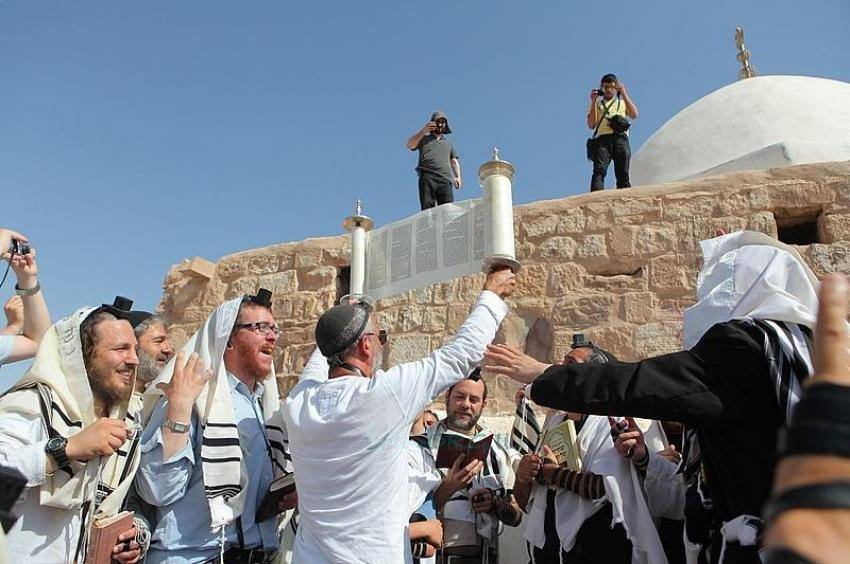
Jews celebrate at Aaron Tomb on Jebal Haroun.
Those who are not acquainted with Jewish pilgrimage sites sometimes think that the Jewish Feasts are the only pilgrimages that Jewish people took.
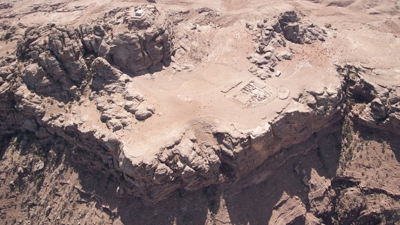
There were also Christian pilgrimages to Petra. Near the top of Mount Haroun there is a very wide flat area where thousands of people can gather. The belief is that Abraham used to climb the mountain and stand on this flat plain (sometimes called the plain of Arafat). And so Christian monks built a hostel there, so that pilgrims could stay the night. This structure can be clearly seen on top of the mountain.
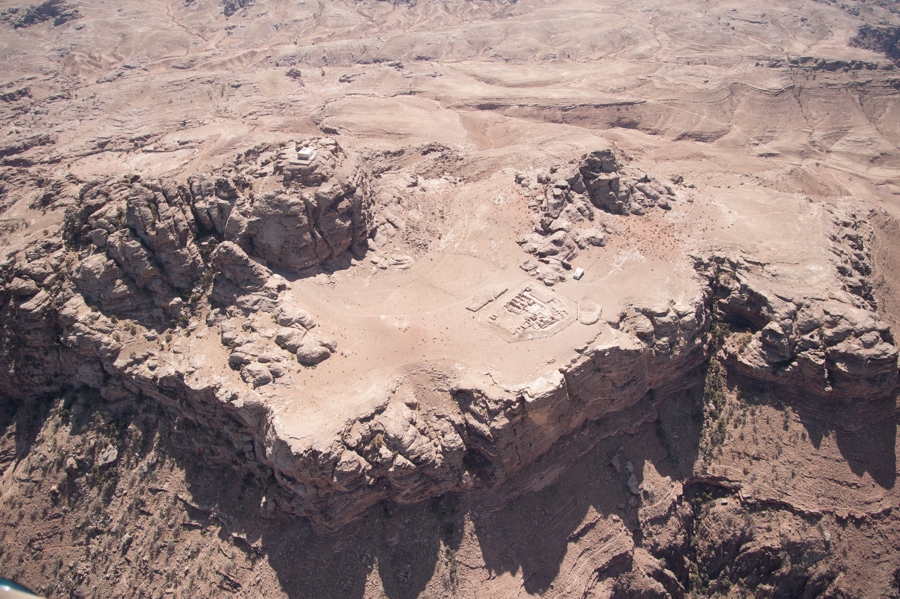
The Christian guesthouse and pilgrimage center can be see on the right hand side of the flat area. High on the left is the tomb of Aaron at the very top of the mountain.
Five hundred years later, as Islam was forming, Muhammad developed an Islamic pilgrimage, making use of the Plains of Arafat as a place where pilgrim would stand until sunset, contemplating on the Day of Resurrection, and the final judgement of mankind. After the pilgrimage moved to Saudi Arabia, the names Becca and Mecca followed this move, and Muslims found new places to call Mount Arafat.
Back in Petra, however, various pilgrimages continued, although during the Islamic era Christian and Jewish pilgrimages faded from practice. In 1985, the Jordanian government declared that the pilgrimage had been reduced to just a local superstition, and it was banned/
Bibliography
Is this Sacred or What? Tourism to Jebel Haroun, Petra Region. The Routledge Handbook of Halal Hospitality and Islamic Tourism. Eds. C. Michael Hall & Girish Prayag.



Page Discussion
Membership is required to comment. Membership is free of charge and available to everyone over the age of 16. Just click SignUp, or make a comment below. You will need a user name and a password. The system will automatically send a code to your email address. It should arrive in a few minutes. Enter the code, and you are finished.
Members who post adverts or use inappropriate language or make disrespectful comments will have their membership removed and be barred from the site. By becoming a member you agree to our Terms of Use and our Privacy, Cookies & Ad Policies. Remember that we will never, under any circumstances, sell or give your email address or private information to anyone unless required by law. Please keep your comments on topic. Thanks!